
Tokenizing U.S. Real Estate: Legal Blueprints, Smart Contracts & On-Chain Workflows
July 11, 2025
1. Introduction
The digital transformation of real estate investment is accelerating at an unprecedented pace. The global real estate tokenization market, while nascent, is poised for significant growth.
According to various industry reports, the global market size for real estate tokenization was valued at approximately $3.5 billion in 2024 and is projected to grow to around $19 billion by 2033, reflecting a robust Compound Annual Growth Rate (CAGR) of approximately 21%.
Despite this current market size, the potential for tokenization is vast. Some analyses, including those by major consulting firms such as Deloitte and McKinsey & Company, predict that the total market for tokenized real estate could reach $3 trillion to $4 trillion by 2030-2035, potentially representing a substantial portion of global real estate assets under management (AUM)*.
Currently, only a fraction of real estate firms utilize tokenization - surveys indicate about 12% of real estate firms had implemented or were piloting tokenization solutions in 2023 - indicating massive untapped potential and a major opportunity for firms that can navigate the complexities of this evolving market.
*Note: The $3 trillion number represents a potential market size under optimal conditions (e.g., strong adoption, favorable regulation) and is generally cited as the Total Addressable Market (TAM), not the actual market capitalization in the near term.
Tokenizing US real estate involves navigating two primary models that serve different investor needs and regulatory requirements:
LLC-Based Ownership (Non-STO) - Direct property ownership through tokenized membership interests
Security Token Offerings (STOs) - SEC-regulated investment vehicles for broader market access
This comprehensive guide explores the legal frameworks, smart contract architectures, tax implications, custody solutions, and yield optimization strategies that define successful real estate tokenization in the US market.
2. Legal Structures
A. LLC Model (Non-STO)
The LLC model represents the most straightforward approach to real estate tokenization, offering direct property ownership through blockchain-based membership interests. This structure leverages the flexibility of US LLC law while maintaining regulatory simplicity.
Core Structure:
Single-property LLCs with membership interest tokens
Token holders become direct LLC members with proportional ownership rights
Not SEC-regulated (if structured to fail the Howey Test)
Operating agreement governs member rights and profit distributions
In most implementations, the token is explicitly referenced in the LLC’s operating agreement or private placement memorandum, enabling legal recourse and validation off-chain.
Technical Implementation:
Token Standards: ERC-20 for fungible membership interests, ERC-721 for unique property shares
Governance: On-chain voting for major decisions, with fallback to traditional LLC voting
Compliance: Optional KYC/AML depending on investor sophistication requirements
Note about ERC-20 vs ERC-721: While ERC-721 (NFTs) can represent unique property shares, for fractional ownership within an LLC, ERC-20 is more common for fungible membership interests. ERC-721 might be used for a single, unique deed or title token, or for representing a specific unique right related to a property, but not for shares, unless those shares are inherently non-fungible (e.g., specific unit numbers with distinct features).
Best For:
Small-scale properties ($100K - $5M)
Accredited investor groups seeking direct ownership
Long-term hold strategies with minimal liquidity requirements
Properties with stable cash flow and appreciation potential
Tax Advantages:
Pass-through taxation eliminates double taxation
Depreciation benefits flow directly to token holders
1031 exchanges possible for property swaps*
State-specific LLC benefits (e.g., Delaware's favorable business climate)
*Note: While the underlying LLC might facilitate a 1031 exchange of the property it holds, the exchange of the tokens themselves typically does not qualify for 1031 treatment, as tokens are generally not considered "like-kind" property for tax purposes. 1031 applies to the underlying real property asset, not the tokens representing interests.
B. STO Model
The Security Token Offering model provides institutional-grade investment vehicles that can serve broader markets while maintaining strict regulatory compliance. This approach enables sophisticated financial products built on blockchain infrastructure.
Core Structure:
SEC-compliant security tokens under Regulation D (506(b)/506©) or Regulation A+
Typically pools multiple properties for diversification
Professional management and fiduciary oversight
Structured as funds, REITs, or special purpose vehicles
These entities typically rely on Delaware statutory trusts or Cayman-exempted structures to streamline fund administration and enable pass-through tax treatment where applicable.
Technical Implementation:
Token Standards: ERC-1400 for partially fungible securities, ERC-3643 for comprehensive compliance
Compliance: Mandatory investor accreditation verification, ongoing KYC/AML monitoring
Distribution: Automated dividend distribution through smart contracts
Secondary Trading: Alternative Trading Systems (ATS) for liquidity provision
Best For:
Large portfolios (>$10M total value)
Institutional investors requiring regulatory certainty
Secondary market liquidity requirements
Global investor base seeking US real estate exposure
Complex financial products (REITs, funds, derivatives)
Regulatory Considerations:
SEC registration requirements and ongoing compliance costs
FINRA broker-dealer relationships for distribution
State blue sky law compliance for multi-state offerings
Foreign investment restrictions under FIRPTA
3. Smart Contract Design
The technical architecture of tokenized real estate varies significantly between LLC and STO models, with different compliance requirements, governance mechanisms, and operational workflows.
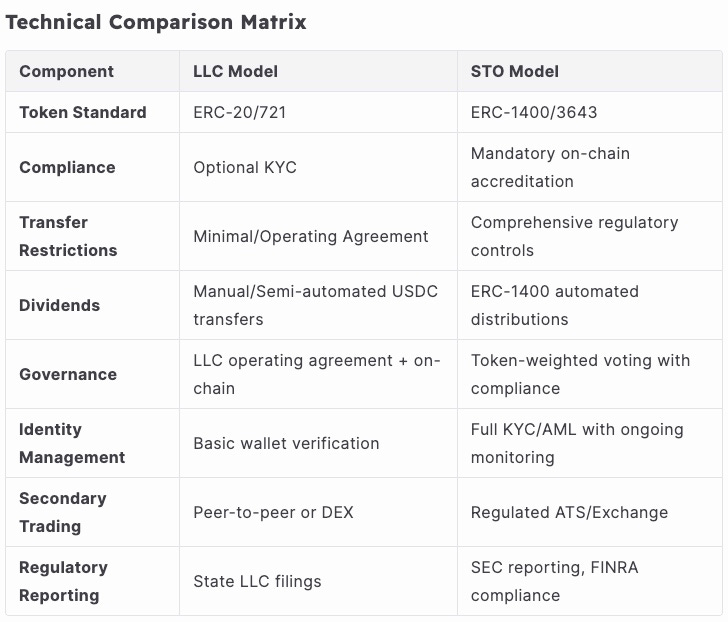
ERC-1400 allows partitioning for restricted and unrestricted tranches, while ERC-3643 separates identity verification from token logic via a controller layer.
Identity Registry + Credential Verification Layer (e.g., ERC-734 / ERC-735 / ERC-3643 identity registry contract)
Advanced Token Standards Comparison
ERC-1400 vs ERC-3643 for Security Tokens:
Both of the standards enable the enforcement of compliance rules and the control of transfers to eligible investors. The ERC-3643 manages compliance by leveraging the security of the blockchain with an automatic validator system. However, ERC-3643 offers several advantages:
Modular Architecture: Separation of token logic from identity verification
Enhanced Compliance: While actual figures are hard to verify, several hundred million $ worth of assets have been tokenized through ERC-3643
Regulatory Flexibility: Supports multiple jurisdictions and compliance frameworks
Operational Efficiency: Automated compliance checking reduces manual oversight
ERC-1400 focuses on segmenting the token supply itself into different "classes" or "partitions," each with its own embedded rules and metadata, allowing for nuanced control over specific token batches.
ERC-3643 focuses on separating the investor's identity and eligibility from the token's core logic, using a modular system of identity registries and compliance controllers to enforce rules on who can hold and transfer the tokens.
4. Workflows
The workflow diagrams presented here are for illustration purposes only, and do not include edge cases and failure conditions.
A. LLC Model Workflow
The LLC model prioritizes simplicity and direct ownership, with streamlined processes for property acquisition, token issuance, and dividend distribution.
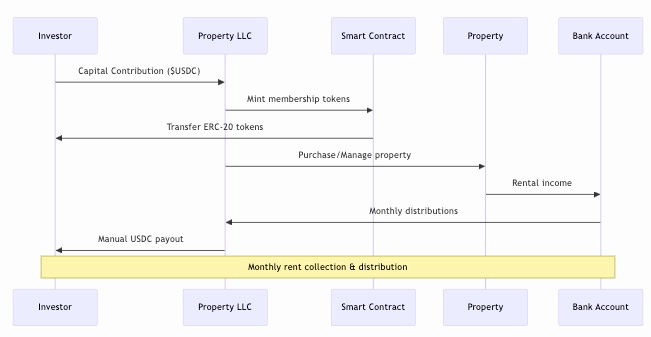
Key Process Steps:
Property Acquisition: LLC purchases real estate with pooled investor capital
Token Issuance: Smart contract mints ERC-20 tokens representing membership percentages
Property Management: Professional management or DAO-governed operations
Income Distribution: Monthly/quarterly distributions based on token holdings
Governance: Token-weighted voting for major decisions (refinancing, sale, etc.)
B. STO Model Workflow
The STO model incorporates comprehensive compliance checks and automated processes suitable for institutional investors and regulated markets.
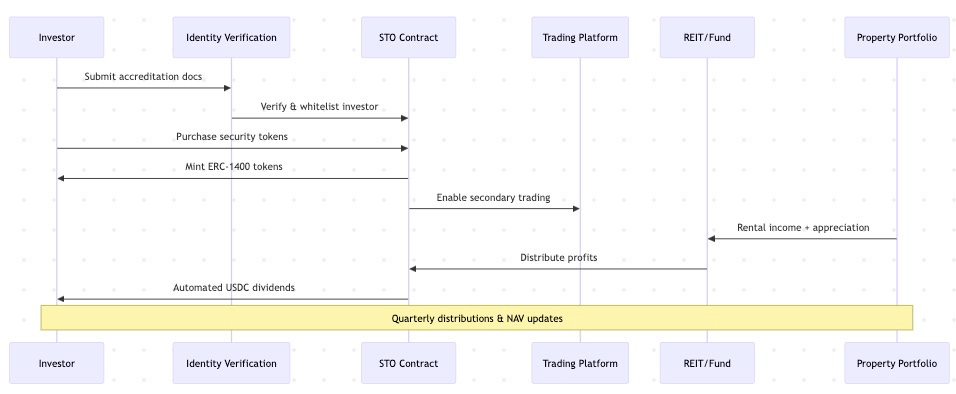
Note: failed KYC validations trigger a rejection message on-chain and an off-chain remediation process. In the event of rent payment failure, the smart contract can record delinquency flags, enabling downstream enforcement or reporting.
Advanced Process Features:
Investor Onboarding: Comprehensive KYC/AML with accreditation verification
Smart Contract Compliance: On-chain enforcement of transfer restrictions
Automated Distributions: Quarterly dividends calculated from net asset value
Secondary Market: Regulated trading on Alternative Trading Systems
Regulatory Reporting: Automated compliance reporting to SEC/FINRA
5. Code Implementation
The code snippets shown here are simplified examples for illustration purposes only. Real-world implementations would require more robust error handling, access control for various functions, and more sophisticated dividend calculation logic.
LLC Token (Enhanced ERC-20)
// SPDX-License-Identifier: MIT
pragma solidity ^0.8.19;

import "@openzeppelin/contracts/token/ERC20/ERC20.sol";
import "@openzeppelin/contracts/access/Ownable.sol";
import "@openzeppelin/contracts/security/ReentrancyGuard.sol";

contract LLCPropertyToken is ERC20, Ownable, ReentrancyGuard {

    // Property and financial tracking
    string public propertyAddress;
    uint256 public propertyValue;
    uint256 public totalRentalIncome;
    uint256 public lastDistributionTimestamp;

    // Member management
    mapping(address => bool) public members;
    mapping(address => uint256) public membershipDate;

    // Events for transparency
    event PropertyPurchased(string propertyAddress, uint256 value);
    event RentalIncomeReceived(uint256 amount);
    event DividendsDistributed(uint256 totalAmount);
    event MemberAdded(address member, uint256 shares);

    constructor(
        string memory _name,
        string memory _symbol,
        string memory _propertyAddress,
        uint256 _propertyValue
    ) ERC20(_name, _symbol) {
        propertyAddress = _propertyAddress;
        propertyValue = _propertyValue;
        lastDistributionTimestamp = block.timestamp;
    }

    function mintMembershipTokens(address to, uint256 shares) external onlyOwner {
        require(to != address(0), "Invalid address");
        require(shares > 0, "Shares must be positive");

        if (!members[to]) {
            members[to] = true;
            membershipDate[to] = block.timestamp;
            emit MemberAdded(to, shares);
        }

        _mint(to, shares);
    }

    function computeRentalIncome() external payable onlyOwner nonReentrant {
        require(msg.value > 0, "No income to distribute");

        totalRentalIncome += msg.value;
        lastDistributionTimestamp = block.timestamp;

        emit RentalIncomeReceived(msg.value);
        emit DividendsDistributed(msg.value);
    }

    function getMembershipInfo(address member) external view returns (
        bool isMember,
        uint256 tokenBalance,
        uint256 ownershipPercentage,
        uint256 memberSince
    ) {
        return (
            members[member],
            balanceOf(member),
            totalSupply() > 0 ? (balanceOf(member) * 100) / totalSupply() : 0,
            membershipDate[member]
        );
    }
}
STO Token (ERC-3643 Compliant)
// SPDX-License-Identifier: MIT
pragma solidity ^0.8.19;

import "@tokenysolutions/T-REX/contracts/token/Token.sol";
import "@tokenysolutions/T-REX/contracts/compliance/Compliance.sol";

contract RealEstateSecurityToken is Token {

    // Property portfolio tracking
    struct PropertyAsset {
        string propertyAddress;
        uint256 acquisitionPrice;
        uint256 currentValue;
        uint256 monthlyRent;
        bool isActive;
    }

    mapping(uint256 => PropertyAsset) public properties;
    uint256 public propertyCount;
    uint256 public totalPortfolioValue;
    uint256 public lastNAVUpdate;

    // Dividend distribution
    mapping(address => uint256) public lastDividendClaim;
    uint256 public totalDividendsDistributed;
    uint256 public currentDividendPerToken;

    // Events
    event PropertyAdded(uint256 indexed propertyId, string propertyAddress, uint256 value);
    event NAVUpdated(uint256 newNAV, uint256 pricePerToken);
    event DividendsDeclared(uint256 totalAmount, uint256 perTokenAmount);
    event DividendsClaimed(address indexed investor, uint256 amount);

    constructor(
        address _identityRegistry,
        address _compliance,
        string memory _name,
        string memory _symbol,
        uint8 _decimals,
        address _onchainID
    ) Token(_identityRegistry, _compliance, _name, _symbol, _decimals, _onchainID) {
        lastNAVUpdate = block.timestamp;
    }

    function addProperty(
        string memory _propertyAddress,
        uint256 _acquisitionPrice,
        uint256 _currentValue,
        uint256 _monthlyRent
    ) external onlyOwner {
        properties[propertyCount] = PropertyAsset({
            propertyAddress: _propertyAddress,
            acquisitionPrice: _acquisitionPrice,
            currentValue: _currentValue,
            monthlyRent: _monthlyRent,
            isActive: true
        });

        totalPortfolioValue += _currentValue;

        emit PropertyAdded(propertyCount, _propertyAddress, _currentValue);
        propertyCount++;
    }

    function updateNAV(uint256[] calldata _propertyIds, uint256[] calldata _newValues)
        external onlyOwner {
        require(_propertyIds.length == _newValues.length, "Arrays length mismatch");

        uint256 newTotalValue = 0;

        for (uint256 i = 0; i < _propertyIds.length; i++) {
            require(_propertyIds[i] < propertyCount, "Property doesn't exist");

            PropertyAsset storage property = properties[_propertyIds[i]];
            property.currentValue = _newValues[i];
            newTotalValue += _newValues[i];
        }

        totalPortfolioValue = newTotalValue;
        lastNAVUpdate = block.timestamp;

        uint256 pricePerToken = totalSupply() > 0 ?
            (totalPortfolioValue * 10**decimals()) / totalSupply() : 0;

        emit NAVUpdated(totalPortfolioValue, pricePerToken);
    }

    function computeDividends() external payable onlyOwner {
        require(msg.value > 0, "No dividends to distribute");
        require(totalSupply() > 0, "No tokens issued");

        currentDividendPerToken = msg.value / totalSupply();
        totalDividendsDistributed += msg.value;

        emit DividendsDeclared(msg.value, currentDividendPerToken);
    }

    function claimDividends() external returns (uint256) {
        require(balanceOf(msg.sender) > 0, "No tokens held");

        uint256 dividendAmount = balanceOf(msg.sender) * currentDividendPerToken;
        require(dividendAmount > 0, "No dividends to claim");

        lastDividendClaim[msg.sender] = block.timestamp;

        (bool success, ) = payable(msg.sender).call{value: dividendAmount}("");
        require(success, "Dividend transfer failed");

        emit DividendsClaimed(msg.sender, dividendAmount);
        return dividendAmount;
    }

    function getPortfolioMetrics() external view returns (
        uint256 totalValue,
        uint256 tokenCount,
        uint256 pricePerToken,
        uint256 totalDividends,
        uint256 lastUpdate
    ) {
        return (
            totalPortfolioValue,
            totalSupply(),
            totalSupply() > 0 ? (totalPortfolioValue * 10**decimals()) / totalSupply() : 0,
            totalDividendsDistributed,
            lastNAVUpdate
        );
    }
}
6. Advanced Considerations
A. Compliance and Regulatory Architecture
Multi-Jurisdictional Compliance:
Federal Level: SEC registration, FINRA compliance, IRS reporting
State Level: Blue sky laws, property transfer taxes, LLC registration
International: FATCA compliance for foreign investors, treaty benefits
Technology Stack for Compliance:
Identity Verification: Integration with KYC providers
Accreditation Verification: Third-party verification services
Ongoing Monitoring: Transaction monitoring, sanctions screening, PEP checks
Audit Trail: Immutable blockchain records for regulatory reporting
B. Operational Infrastructure
Property Management Integration:
Rent Collection: Automated collection through property management software
Maintenance Coordination: Smart contract-triggered maintenance requests
Insurance Management: Parametric insurance for property coverage
Vacancy Management: Automated tenant acquisition and screening
Financial Infrastructure:
Banking Integration: Institutional-grade banking with crypto-fiat bridges
Accounting Systems: Real-time P&L tracking, tax reporting automation
Treasury Management: Yield optimization on idle capital, stablecoin strategies
Risk Management: Diversification algorithms, stress testing, portfolio rebalancing
C. When to Choose Each Model
LLC Model Optimal Scenarios:
Single-family homes or small multi-family properties
Target property value: $500K - $5M
Investor group: 5-50 accredited investors
Investment horizon: 5-10 years
Geographic focus: Single state or region
Example: $2M duplex in Austin, TX with 8 accredited investors seeking 8% annual returns
STO Model Optimal Scenarios:
Large commercial properties or diversified portfolios
Target portfolio value: $25M+
Investor base: 100+ investors (accredited and sophisticated)
Investment horizon: 3-7 years with liquidity options
Geographic scope: National or international
Example: $100M portfolio of 25 rental properties across 5 states, targeting institutional investors
D. Performance Metrics and Benchmarking
Key Performance Indicators:
Financial Metrics: IRR, Cash-on-Cash returns, Total returns, NAV growth
Operational Metrics: Occupancy rates, Rental yield, Operating expense ratios
Token Metrics: Trading volume, Token price stability, Dividend yield
Compliance Metrics: KYC completion rates, Transfer restriction violations, Regulatory audit results
Market Benchmarking:
Traditional REITs: 6-12% annual returns, high liquidity, professional management
Direct Real Estate: 8-15% annual returns, low liquidity, hands-on management
Tokenized Real Estate: 7-13% annual returns, medium liquidity, hybrid management model
7. Risk Management and Mitigation
A. Technology Risks
Smart Contract Vulnerabilities:
Mitigation: Comprehensive auditing by reputed security & auditing firms
Insurance: Smart contract insurance through insurance protocols
Monitoring: Real-time monitoring
Blockchain Infrastructure Risks:
Network Congestion: Multi-chain deployment
Validator Risks: Diversified staking across multiple validators
Upgrade Risks: Timelocked upgrades with community governance
B. Regulatory Risks
Compliance Evolution:
Monitoring: Continuous monitoring of SEC guidance, state regulations
Adaptation: Modular smart contract architecture for regulatory updates
Legal Counsel: Ongoing relationships with securities attorneys
International Considerations:
Tax Treaties: Optimization of withholding taxes for international investors
Regulatory Arbitrage: Jurisdiction selection for optimal compliance costs
Cross-Border Compliance: GDPR, AML5, other international requirements
8. Future Developments and Trends
A. Technological Evolution
DeFi Integration:
Lending Protocols: Property-backed lending through Aave, Compound
Yield Farming: Liquidity mining for tokenized real estate
Derivatives: Options, futures, and swaps on real estate tokens
Interoperability:
Cross-Chain Bridges: Seamless transfer of real-estate tokens across chains
Layer 2 Solutions: Reduced transaction costs through Layer-2 chains or equivalent
Enterprise Integration: APIs for traditional real estate platforms
B. Market Evolution
Institutional Adoption:
Pension Funds: Allocation of institutional capital to tokenized real estate
Insurance Companies: Portfolio diversification through real estate tokens
Family Offices: Direct investment in tokenized properties
Retail Accessibility:
Fractional Ownership: Minimum investments as low as $100
Mobile Platforms: User-friendly apps for retail investors
Educational Resources: Investor education and financial literacy programs
Conclusion
The choice between LLC and STO models fundamentally depends on your investment objectives, target market, and operational complexity tolerance. Blockchain-based real estate tokenization can reduce transaction costs by up to 50%, making both models attractive for different use cases.
Choose LLC Model When:
You need direct property ownership with minimal regulatory overhead
Your investor base is small and sophisticated
You're focusing on single properties or limited portfolios
Long-term hold strategies align with your investment thesis
Choose STO Model When:
You require institutional-grade compliance and reporting
You're targeting broader markets with liquidity needs
You're managing diversified portfolios requiring professional oversight
Secondary market trading is essential for investor exits
The rapid growth of the tokenized real estate market and the market projections suggest that both models will coexist and serve different segments of the evolving digital asset ecosystem. Success in either model requires careful attention to smart contract design, regulatory compliance, and operational excellence.
As the technology matures and regulatory frameworks solidify, we can expect to see increased standardization, lower barriers to entry, and more sophisticated financial products built on tokenized real estate infrastructure. The key is to start with a model that matches your current capabilities while building towards the more sophisticated features that will define the future of real estate investment.
Real estate tokenization is rapidly evolving, and practical insights from builders are invaluable for the entire ecosystem. If you are building in this space, reach out and share your views and experiences in real-estate tokenization.
This post is part of a newsletter Quantra Pulse. Subscribe for free at pulse.quantra.finance to receive new posts.