
The Missing Coordination Layer for Crypto
Unlocking Crypto’s Real-World Potential

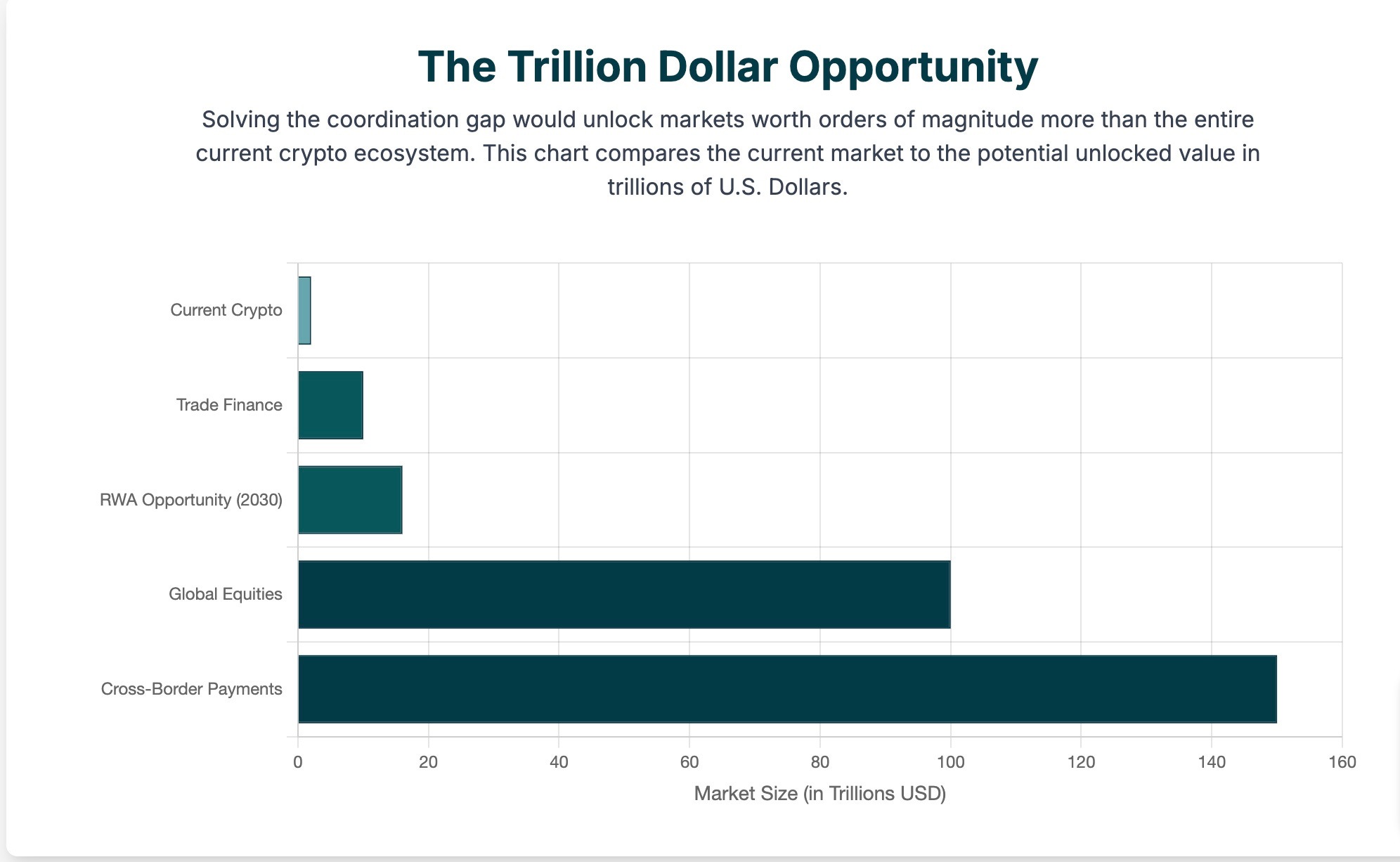
Blockchain technology has rewired how we think about trust. Layer-1 chains like Ethereum deliver tamper-proof ledgers. Rollups scale computations with cryptographic proofs. Oracles feed real-world data like prices or weather into smart contracts. Yet, despite these leaps, a crucial question looms: Why isn’t the $150 trillion cross-border payments market, the $10 trillion trade finance sector, or BlackRock’s $10 trillion in assets flowing onto crypto rails? The answer lies in a missing coordination layer that bridges the pristine logic of blockchains with the messy, regulated workflows of real-world finance.
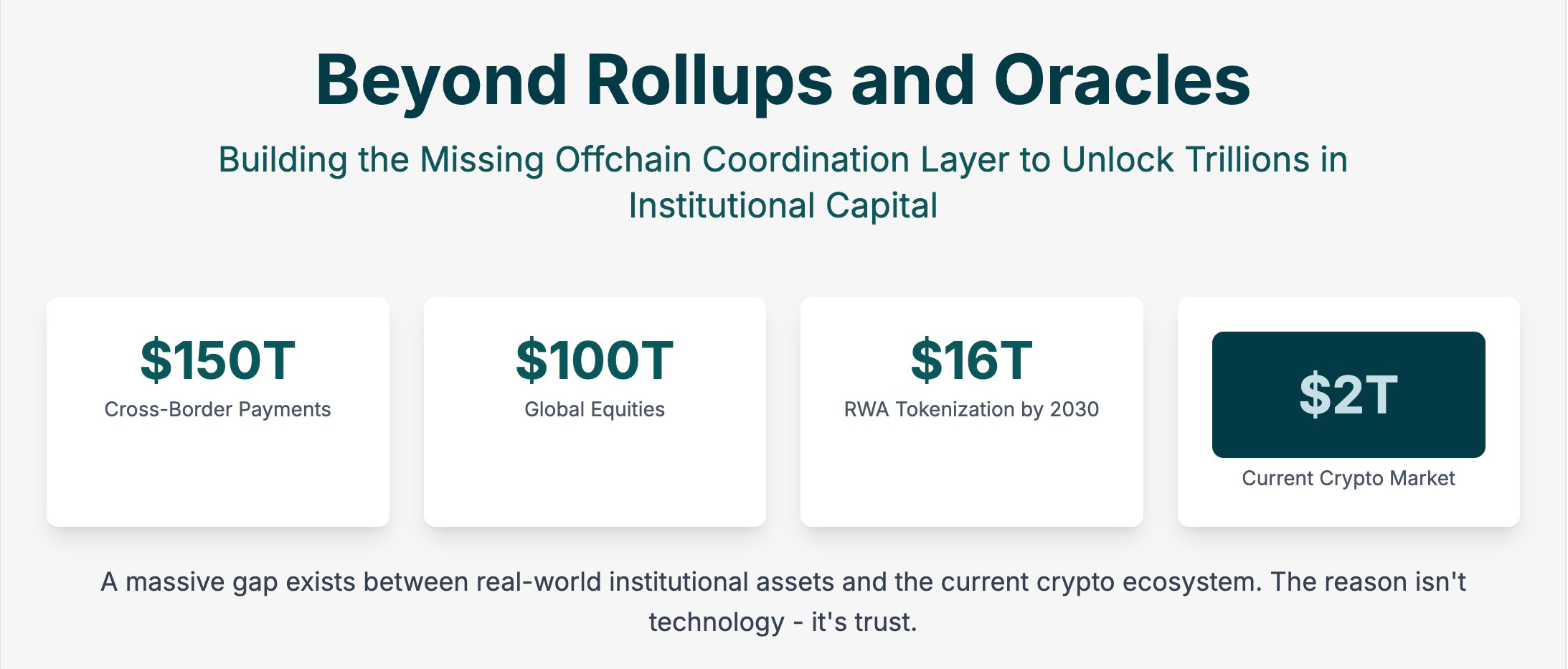
This gap isn’t about code failing to execute or data being unavailable. It’s about proving that complex, multi-party processes - spanning humans, systems, and jurisdictions - happened correctly, compliantly, and at the speed of modern markets. Without this layer, institutional capital stays sidelined, and crypto remains a $2 trillion sandbox chasing its own tail. To make this visceral, let’s explore three high-stakes domains - stablecoin issuance, asset tokenization, and trading systems - where the lack of a coordination layer is the bottleneck, and why solving it could unlock trillions for the global economy.
The Problem: Why Coordination Is the Missing Piece
Blockchains excel at two things: proving computation (via Layer-1s and rollups) and proving data (via oracles). Layer-1 chains like Solana or Ethereum execute smart contracts with deterministic finality. Rollups, like Arbitrum or zkSync, batch transactions and anchor proofs on-chain, scaling DeFi to millions of users. Oracles, like Chainlink, deliver verified price feeds or event triggers, enabling derivatives or insurance contracts. Together, they form a robust stack for crypto-native applications - think Uniswap’s AMMs or Aave’s lending pools.
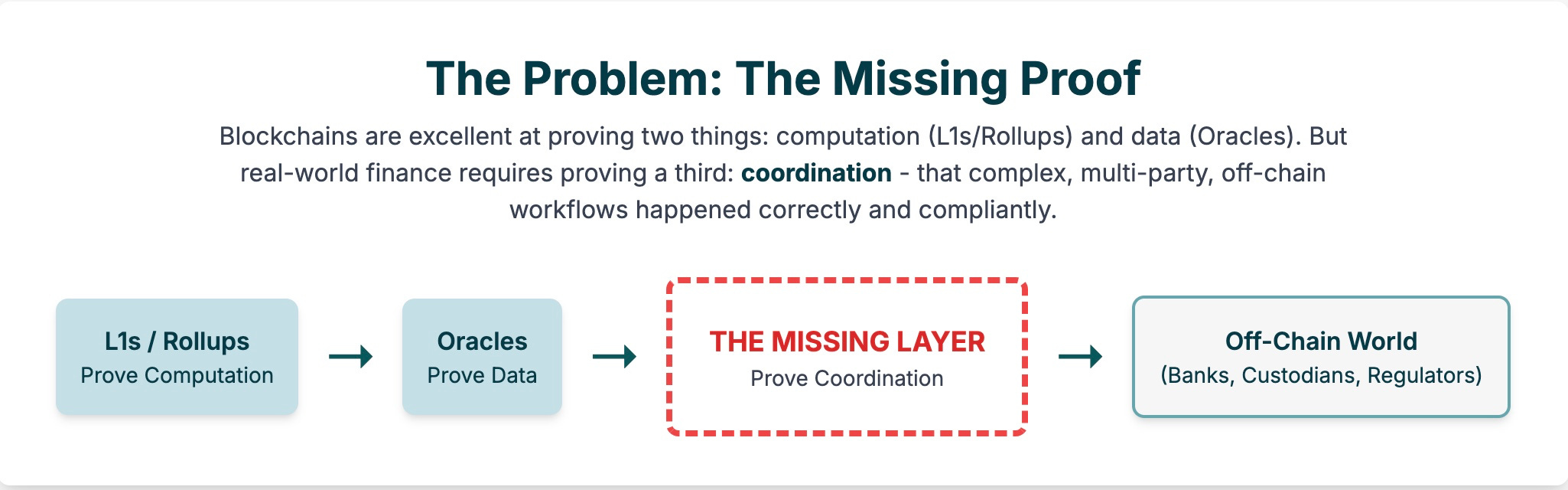
But real-world finance isn’t crypto-native. It’s a tangle of off-chain actors (banks, custodians, regulators), proprietary systems (SWIFT, ERP platforms), and jurisdictional rules (MiCA in Europe, GENIUS Act in the U.S.). These workflows demand coordination: proving that the right parties took the right actions, in the right order, under the right policies. Rollups can’t orchestrate off-chain custodians. Oracles can’t verify multi-step processes. Layer-1s choke on the microsecond-latency demands of high-frequency trading. The result? A trust gap that keeps institutional capital - $100 trillion in global equities, trillions in corporate treasuries - locked out.
Use cases needing off chain coordination layer
The coordination layer isn’t a new blockchain or protocol. It’s a framework to orchestrate off-chain and on-chain actions, leveraging existing infrastructure (Layer-1s, rollups, oracles) to prove compliance and alignment at scale. Think of it as the conductor for a financial symphony: It doesn’t replace the instruments (blockchains, oracles) but ensures every player - trader, bank, auditor - hits their cue, with proofs anchored on-chain. Let’s see this gap in action across three critical use cases.
Use Case 1 - Stablecoin Issuance and Compliance
Regulatory Rails for Programmable Money
Stablecoins are crypto’s killer app, with $200 billion in market cap powering DeFi and remittances. The market is currently dominated by centralized stablecoins like USDC (Circle) and USDT (Tether), which rely on off-chain bank accounts and audits to maintain their 1:1 USD peg and, crucially, to manage compliance. Now imagine a global institution like J.P. Morgan (JPM) issuing a tokenized deposit, like JPM Coin, for instant inter-bank settlement. The promise: Atomic, near-zero-fee settlement compared to the multi-day, cost-heavy process of traditional correspondent banking. Blockchain rails can handle this today - smart contracts for issuance, oracles for collateral pricing.
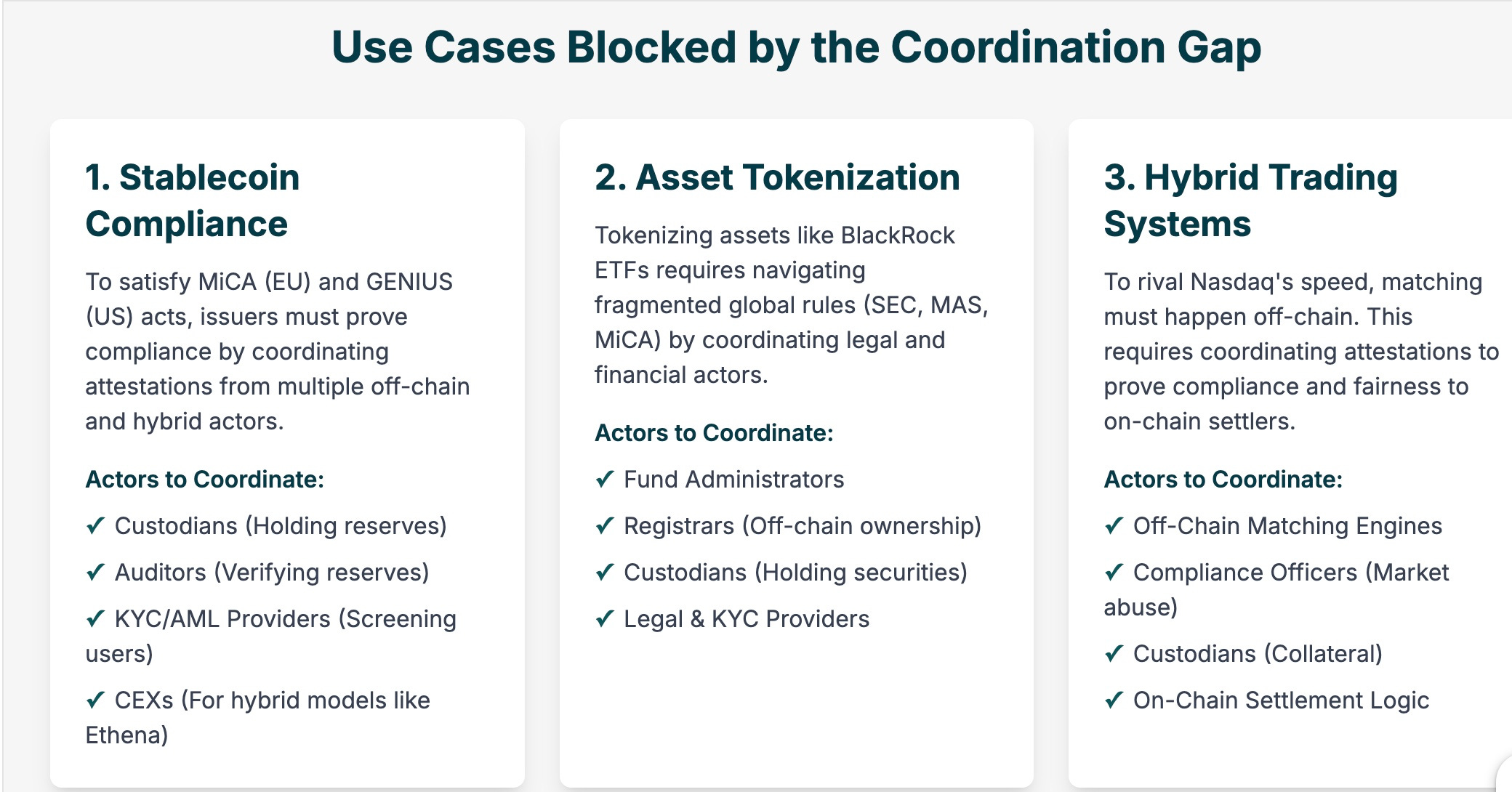
The Problem: Regulatory compliance. The current structure of USDC, which is highly regulated and emphasizes attested reserves, is the closest model to institutional acceptability. However, even USDC issuance involves critical off-chain coordination: proving reserves are held in compliant, segregated accounts and enforcing AML/sanctions lists via off-chain systems. Similarly, the newer, crypto-native model of Ethena (USDe), which uses delta-hedging with staked crypto collateral, still relies on a complex network of centralized exchanges and custodians for its derivative positions and risk management. Under the U.S.’s GENIUS Act (effective mid-2026), payment stablecoin issuers must register, maintain 1:1 reserves in low-risk assets, and enforce AML/sanctions via the Bank Secrecy Act. Europe’s MiCA framework, live since December 2024, demands similar for e-money tokens: authorization, redemption rights, and liquidity safeguards. A vendor in a sanctioned region? Geoblock them instantly. Suspicious transaction? Flag it for audit. These rules require real-time coordination across:
Off-Chain Actors (Relevant to USDC/USDT/JPM Coin): Custodians holding reserves, auditors verifying compliance, and KYC/AML providers checking counterparties.
Hybrid Actors (Relevant to Ethena USDe): Centralized exchanges providing derivative liquidity and managing short positions.
On-Chain Logic: Smart contracts executing transfers or managing pools of tokenized deposits.
Regulatory Reporting: Audit trails for OCC, ESMA, or similar oversight.
Why Existing Infra Fails: Rollups can settle transactions but can’t orchestrate off-chain custodians or enforce geofencing necessary for all three types of stablecoins (fiat-backed, asset-backed, or synthetic). Oracles can verify reserve values but not the sequence of actions (e.g., “custodian reserved funds, then auditor approved”). Layer-1s choke on the real-time KYC/sanctions checks required in institutional settings. Without a coordination layer, whether you are running a regulated fiat-backed model (like USDC for institutions) or a hybrid crypto-native model (like Ethena), the compliance team faces a nightmare: Fragmented systems, manual oversight, and no way to prove to regulators that every single step was followed. The result? Stablecoin pilots stall, and $150 trillion in cross-border payments stays off-chain.
What’s Needed: A coordination layer that orchestrates attestations - digital receipts from custodians, auditors, and KYC providers (for fiat-backed models) or from derivative exchanges and risk managers (for synthetic models) - into a verifiable proof. This proof, anchored on a Layer-1 or rollup, confirms: “Reserves were verified, AML checks passed, and funds transferred per MiCA/GENIUS rules.” Off-chain execution ensures low latency; on-chain proofs ensure trust. This unlocks programmable money for corporate treasuries, slashing costs and enabling yield optimization, all while satisfying regulators.
Use Case 2: Asset Tokenization
From Illiquid Assets to Liquid Markets
Tokenization - turning real-world assets (RWAs) like real estate, bonds, or trade finance credits into on-chain tokens - is a $16 trillion opportunity by 2030, per BCG estimates. Picture a fractionalized portfolio of BlackRock iShares ETFs (Exchange Traded Funds) tokenized into ERC-20 tokens for instant, 24/7 trading. Or a $1B corporate bond with programmable yields, traded on a DeFi AMM. The tech is ready: Ethereum for token minting, Chainlink for asset valuations, rollups for scalable trading.
The Problem: Regulatory fragmentation and coordination complexity. Singapore’s MAS requires provenance proofs and AML checks. MiCA mandates transparency for asset-referenced tokens, including reserve audits and investor disclosures. The U.S. SEC demands accredited investor verification for private securities. Tokenizing a fund involves:
Off-Chain Actors: Fund administrators, registrars maintaining official ownership records, custodians holding the underlying securities, and KYC providers screening investors.
On-Chain Logic: Minting ERC-1404 tokens with compliance metadata (e.g., transfer restrictions to accredited investors or geofenced regions).
Cross-Jurisdictional Rules: Geofencing U.S. investors per SEC rules, ensuring MiCA-compliant disclosures for EU buyers.
Why Existing Infra Fails: Oracles can fetch valuation data but can’t prove a custodian secured the asset or a registrar updated the off-chain ledger. Rollups can mint tokens but can’t orchestrate off-chain legal reviews or real-time KYC. Layer-1s are too costly for high-frequency investor checks. Without coordination, tokenization grinds to a halt: Developers cobble together bespoke integrations, custodians balk at unproven workflows, and regulators flag missing audit trails. The $10 trillion trade finance market - think letters of credit as smart contracts - faces the same wall.
What’s Needed: A coordination layer that stitches together off-chain attestations (e.g., “Underlying assets secured; deed verified; KYC completed”) and on-chain actions (token minting, trading). This layer would use existing rollups for settlement and oracles for data, but add a new capability: Composing multi-party proofs that satisfy MiCA’s reserve rules or SEC’s investor restrictions. Execution happens off-chain for speed; proofs anchor on-chain for trust. This could tokenize billions in bonds and funds, creating liquid markets where illiquid assets once languished.
Use Case 3: Trading Systems
Fast Off-Chain, Trusted On-Chain
Crypto exchanges are DeFi’s crown jewel, with trillions in potential if they bridge to TradFi. Imagine a hybrid exchange where tokenized private equity serves as collateral in lending pools, but only for accredited investors. Or a high-frequency trading platform matching orders in microseconds, with settlements on a rollup. The tech stack exists: Rollups for settlement, oracles for price feeds, Layer-1s for finality.
The Problem: Speed and compliance don’t mix. High-frequency trading demands off-chain matching engines for microsecond latency - blockchains, even rollups, can’t keep up (seconds at best). But regulators demand oversight: MiCA’s market abuse prevention requires real-time surveillance for wash trading; GENIUS mandates issuer registration and circuit breakers for systemic risks. A trading system needs:
Off-Chain Execution: Matching engines pairing orders instantly, with fairness proofs (e.g., no front-running).
On-Chain Settlement: Updating balances or collateral in a rollup or Layer-1.
Regulatory Guardrails: Verifying investor accreditation, enforcing geofencing, and triggering circuit breakers if volatility spikes.
Why Existing Infra Fails: Rollups are too slow for matching, and their on-chain logic can’t integrate proprietary engines. Oracles can provide price data but can’t prove a matching engine was unbiased or that circuit breakers fired correctly. Layer-1s like Solana are fast but lack the flexibility to coordinate off-chain systems with regulatory hooks. Without a coordination layer, exchanges either sacrifice speed (fully on-chain, lagging markets) or compliance (off-chain, risking fines). Institutional traders, managing $ trillions, stay away.
What’s Needed: A coordination layer that runs off-chain matching at native speeds, collects attestations from engines, custodians, and compliance officers (e.g., “Order matched fairly; investor accredited; no abuse detected”), and anchors proofs on-chain. This layer would leverage rollups for settlement and oracles for prices, but add the missing piece: Verifiable coordination of regulated workflows. The outcome? Hybrid exchanges that rival Nasdaq’s speed while satisfying SEC or ESMA auditors, opening DeFi to institutional volume.
Architectural Approaches to the Coordination Layer
The gap for real-world finance is clear: we need to enforce off-chain compliance with on-chain trust. The question for builders is, what is the best architectural approach to deliver this missing layer? Currently, four primary models are emerging, each offering a distinct trade-off between decentralized security, flexibility, and real-world adoption.
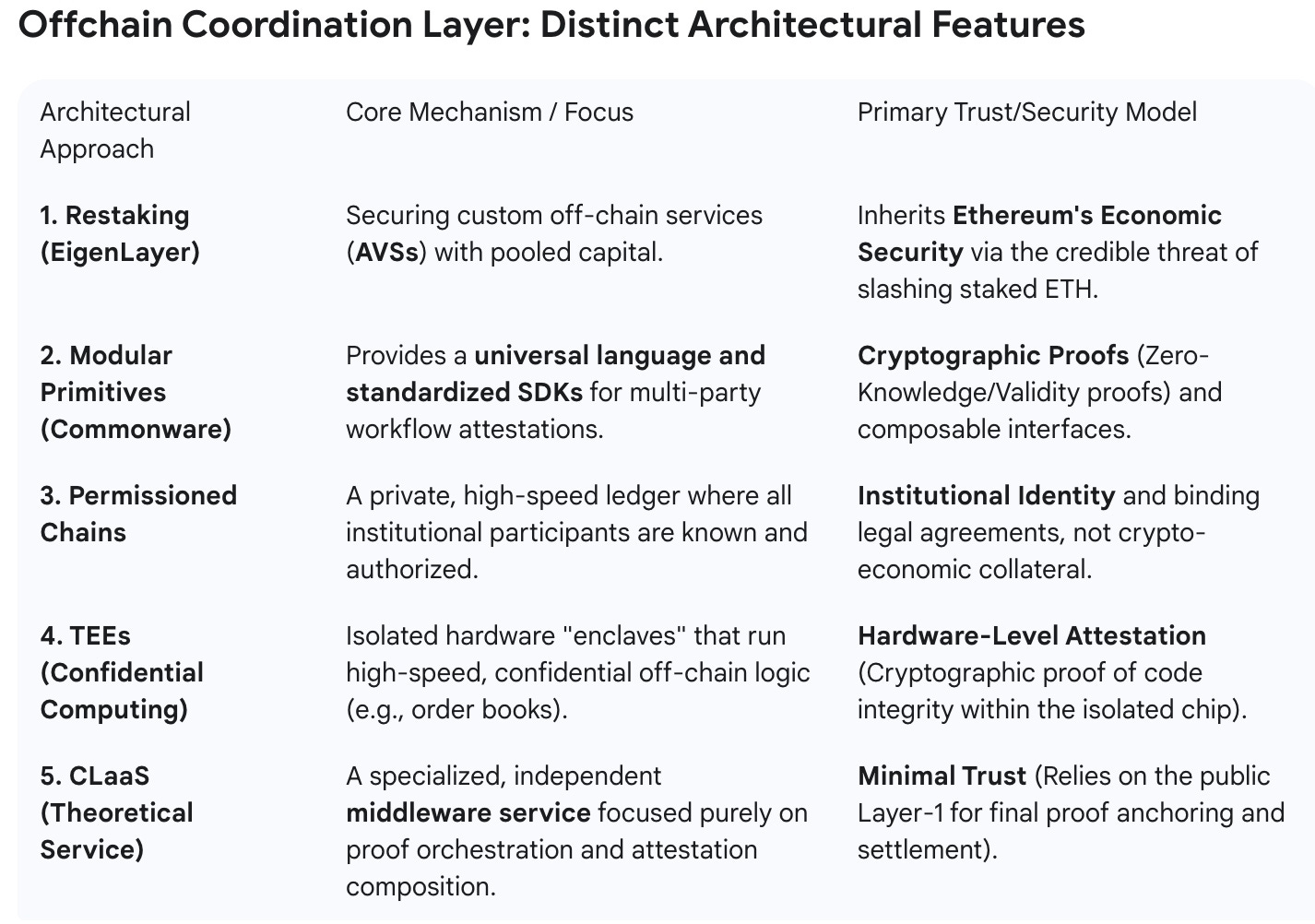
1. Economic Security via Restaking (e.g., EigenLayer)
This model proposes that the ultimate primitive of trust is the massive, decentralized economic stake in a base Layer-1, specifically Ethereum. Projects like EigenLayer function as a trust marketplace, enabling stakers to “restake” their existing ETH to provide security services for new, custom-built Actively Validated Services (AVSs).
How it solves coordination: An AVS can be purpose-built to execute complex coordination tasks, such as verifying that custodians signed off on reserve proofs, sequencing KYC checks, or acting as a cryptoeconomically-secured bridge for RWA data. The security guarantee comes from the credible threat of slashing the restaked ETH if the AVS misbehave or coordinates actors incorrectly. This allows the coordination layer to inherit Ethereum’s security without being confined to its execution environment.
2. Modular Primitive Frameworks (e.g., Commonware)
This approach focuses on standardization and interoperability, viewing the coordination layer as a set of open-source tools or SDKs, rather than a single protocol or chain. A conceptual framework, which we can call Commonware, would define standard formats for cross-chain and off-chain data artifacts (like the “attestations” mentioned earlier).
How it solves coordination: It provides developers with a universal language to express multi-party workflows, compliance proofs, and state transitions, regardless of the underlying blockchain (Layer-1, rollup) or off-chain system (SWIFT, ERP). Instead of relying on a singular pool of security (like restaking), this model relies on cryptographic proofs (zero-knowledge or validity proofs) and the composability of standardized interfaces to anchor compliant state on-chain.
3. Permissioned/Consortium Chains
This model represents the traditional finance answer to coordination. These systems (like Hyperledger Fabric or R3 Corda) rely on a permissioned network where all participants (banks, regulators) are known and authorized.
How it solves coordination: The entire coordination workflow, from verifying the transaction to checking compliance rules, runs on a private, high-speed ledger. The trust is based on institutional identity and legal agreements, not economic collateral. Public Layer-1s are typically only used for a final, summary proof of state or for token settlement between permissioned silos. This offers regulatory comfort and high speed but sacrifices the permissionless access and censorship resistance of the public blockchain ethos.
4. Confidential Computing via Trusted Execution Environments (TEEs)
This hardware-based approach is used to guarantee the integrity and confidentiality of off-chain computation. TEEs (like Intel SGX or AMD SEV) create a secure, isolated “enclave” within a processor where code can execute and data can be processed, shielded from the host operating system, hypervisor, or even system administrators.
How it solves coordination: For tasks requiring high-speed or confidential logic (like matching engine order books or processing private KYC data), the coordination logic runs inside the TEE. Remote Attestation allows a party (e.g., the smart contract on Ethereum) to cryptographically verify that the correct, unmodified code is running inside a genuine TEE and that the process executed correctly. This allows for fast, confidential off-chain execution while providing an immutable, verifiable proof of integrity to the public blockchain. TEEs are often used in conjunction with rollups or Layer-1s to prove that a sensitive workflow was handled compliantly. Recent initiatives like Tee.fail have put a dent in the hardware security model, but as long as the threat model is clearly understood, there is a place for hardware-based solutions for execution with verified integrity.
5. The Coordination Layer as a Service (CLaaS)
How it solves coordination: This theoretical fifth model could be seen as an extension of the Modular Frameworks, but delivered as a specialized, independent protocol. It is a service built upon the cryptographic and state machine primitives defined in Option 2. It would focus purely on the orchestration and attestation logic - the “middleware” - without operating its own full ledger or consensus mechanism. It would rely on the security of the public Layer-1 (like Ethereum) for final proof anchoring, the speed of rollups for settlement, and the legal and identity security of the participants (like banks and auditors) for the off-chain execution. This approach minimizes the trust assumptions in the new protocol itself, specializing only in composing proofs from disparate sources.
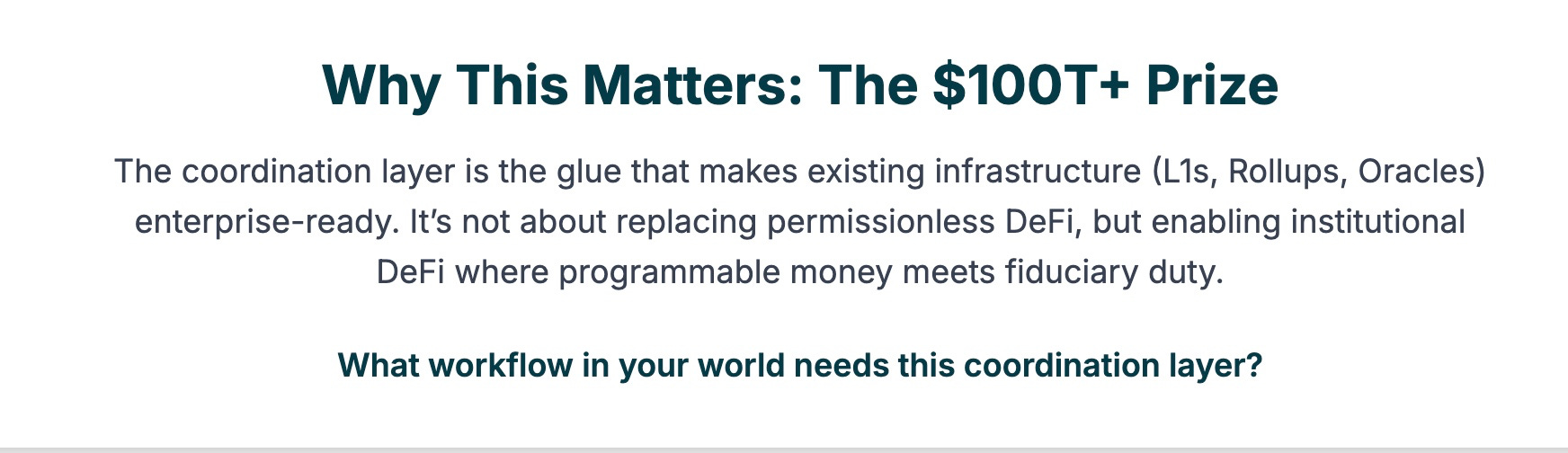
Why This Matters: The Trillion-Dollar Opportunity The coordination layer isn’t a shiny new blockchain - it’s the glue that makes existing infra (Layer-1s, rollups, oracles) enterprise-ready. Without it:
Stablecoins remain niche toys, not corporate tools, locking out $150 trillion in payments.
Tokenization stalls, leaving $16 trillion in RWAs untapped by 2030.
Trading systems stay niche, missing $100 trillion in equities and derivatives.
With it, crypto becomes the backbone of global finance. A coordination layer would prove that JPM’s tokenized deposit complied with GENIUS, that a fund was tokenized per MiCA, or that a crypto exchange matched orders without market abuse. It’s not about replacing permissionless DeFi - it’s about enabling institutional DeFi, where programmable money meets fiduciary duty.
The pieces are here: Ethereum’s finality, Arbitrum’s scalability, Chainlink’s data. What’s missing is the orchestration - attestations from off-chain actors, composed into proofs, executed at real-world speeds, and anchored on-chain. This layer could be open-source, leveraging modular primitives like those from recent blockchain toolkits. It’s a call to builders, treasurers, and regulators: Let’s bridge this gap.
Here is a summary of the five architectural options:
A Call To Action
The coordination layer is the linchpin for crypto’s next leap. If you’re a developer hitting compliance walls, a treasurer eyeing blockchain pilots, or an investor betting on institutional adoption, this is your challenge. How do we orchestrate real-world finance on crypto rails? Share your thoughts, join the conversation, or explore the regulatory frameworks shaping this space (MiCA, GENIUS). The $100 trillion prize awaits.
What workflow in your world needs this coordination layer? Let’s talk.