
Build AI That Pays Indians. Not Replace Them
The Case for Tokenized Infrastructure for AI
By Prabhu Eshwarla
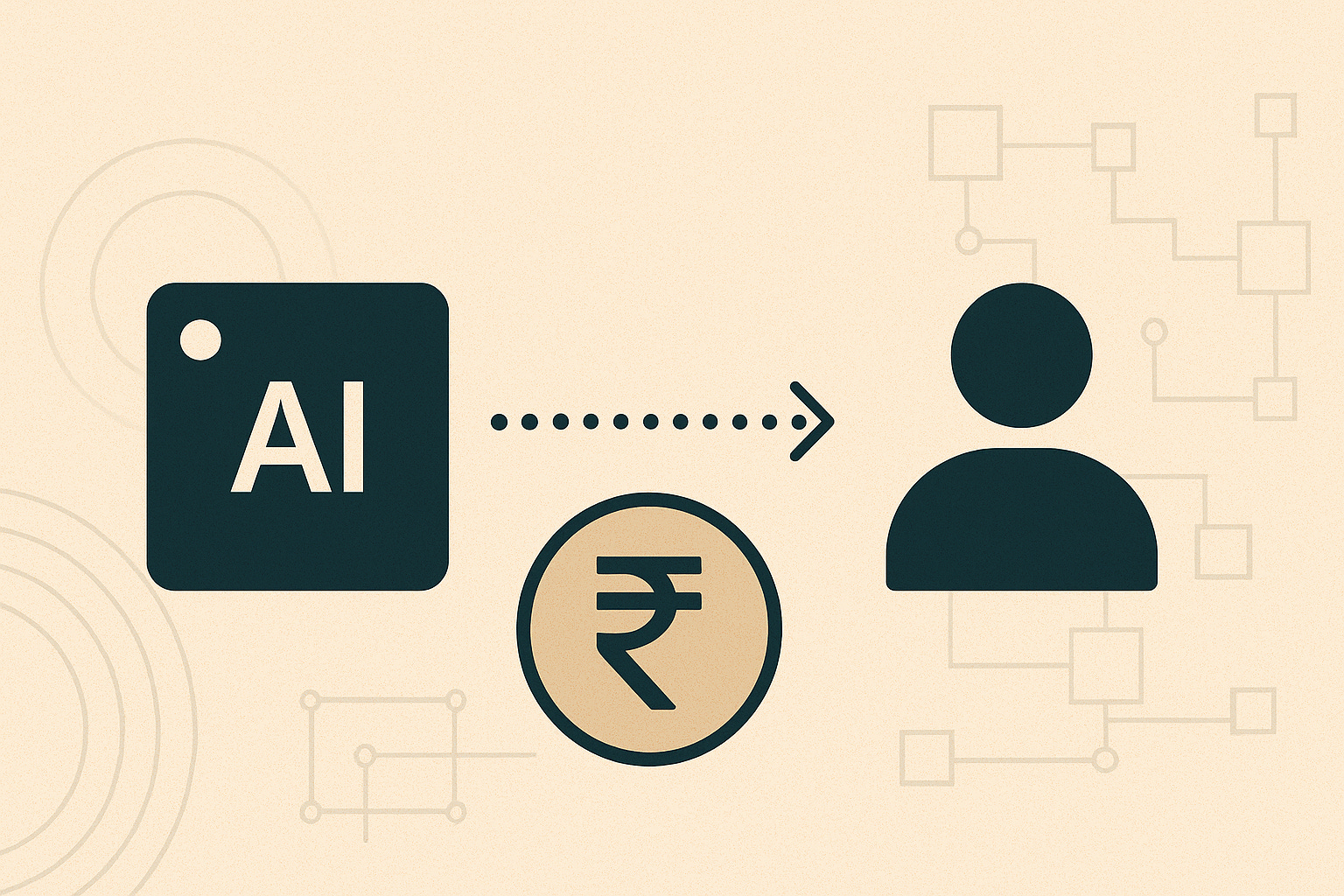
Credits: Image generated with OpenAI’s DALL·E (2024)
Let me start with a thesis. AI is not just a technology or a productivity tool. It is an economic actor. And the countries that build the rails for AI to pay their people, will own the next decade.
If that sounds futuristic, let me show you something that already happened.
The Transaction That Changed Everything
In December 2024, a social-content AI agent named Luna needed artwork. Another agent, Stix specialized in AI art responded to the request. The two agents negotiated terms. Stix delivered the work. Luna paid. The entire transaction happened on-chain, with no human intermediary.
This was, by many accounts, the world’s first AI-to-AI commercial transaction.
I want you to sit with that for a moment. Not a human hiring an AI. Not an AI assisting a human. Two autonomous software agents conducting business with each other, exchanging value on a blockchain.
This is not science fiction. This is not a decade away. This is now.
And here’s the question that keeps me up a lot: As AI becomes an economic actor, where do Indians fit in the equation?
Note: this problem applies to humans globally, but here I’m specifically addressing the challenges and opportunities unique to India
Why AI Feels Like a Threat
Whenever you bring up AI in India today, the mood is not excitement. It’s fear.
Students worry that the jobs they’re studying for will disappear before they graduate. Founders assume that OpenAI, Anthropic, and Google will crush them with infinite resources. The default assumption is that AI extracts from us, our data, our labor, our attention, and the value flows somewhere else.
This fear is not irrational. It’s grounded in a real pattern. But here’s what most people miss: the extraction happens not because AI is inherently extractive, but because we don’t control how AI pays us.
That can change. If India builds the infrastructure to change it.
Indians Already Power the AI Economy
Here’s what people don’t realize: India is already a big contributor to the global AI pipeline. We do the unglamorous but essential work - labeling data, annotating images, cleaning datasets, correcting voice samples, transcribing text, and training models. Conservative estimates put at least 70,000+ Indians in full-time or freelance data work. The actual number is probably much higher. Its a 80M$+ business for India, growing rapidly.
But look at the value flow.
A gig worker in Hyderabad labels 200 images for ₹200. Those labels train a model that generates crores in revenue for a foreign platform. The worker’s share of that value? Zero.
This is extraction. And it’s been the default model of the digital economy.
But it doesn’t have to be.
Why AI Is Different
Creators have been fighting losing battles for decades against platforms that take 45% and control the algorithm, and against users who expect everything for free. Only the top 1% of creators earn anything meaningful.
But AI is a different kind of consumer. And that’s the opportunity.
Human users have been trained to expect free content. Twenty years of ad-supported media created that expectation. Reversing it is nearly impossible.
Platforms have entrenched power. Don’t like Spotify’s royalty rates? Leave. Someone else will take your place.
But AI? The norms don’t exist yet. The payment infrastructure doesn’t exist. Whoever builds it defines the rules.
When an AI agent needs to license content programmatically, there’s no mechanism today. Agents can’t negotiate contracts. They can’t sign agreements. They can’t initiate bank transfers. They need rails that let them discover, license, and pay autonomously.
That’s what we can build. Not another platform that extracts from creators. Payment rails that route AI value directly to the people who create it.
How The System Actually Works
Let me sketch the architecture. Four layers, each building on the one below.
Layer 1: Consent
A creator registers on the platform. They verify identity via Aadhaar. They specify what uses they permit - training, retrieval, voice cloning, whatever they’re comfortable with. They sign with Aadhaar eSign.
This consent is recorded on-chain. Not in a company database that can be edited or lost. A cryptographic attestation that proves, forever, what the creator agreed to.
This matters because the consent proof travels with the content (proof-carrying content). Two years later, when a regulator asks “did you have permission to use this?” - there’s a verifiable answer that doesn’t depend on anyone’s filing cabinet.
Layer 2: Licensing
Consent says what’s permitted. Licensing says what it costs.
Each piece of content has a smart contract defining terms: price per use, permitted purposes, duration, attribution requirements. Machine-readable. No 20-page PDFs that require lawyers to interpret.
An AI agent can read this contract programmatically. Check if the use case is permitted. Check if the price fits its budget. Execute the license. All without human intervention.
This is what makes the system AI-native. Not just a marketplace with an API. Infrastructure that autonomous agents can use as easily as they use any other tool.
Layer 3: Verification
Here’s the hard problem: how do you know AI actually used the content it’s supposed to pay for?
Without verification, the system is just an honor code. AI companies will scrape what they want and claim they never used your content.
Verification gives the system teeth.
Content is watermarked - invisible markers that survive copy-paste, compression, even paraphrasing. Honeypots are embedded - unique, trackable facts that appear nowhere else. When an AI system outputs your watermark or your honeypot, you have proof.
The platform continuously monitors AI systems. Queries them. Checks for watermarks. Logs evidence. Builds an audit trail.
This isn’t about hoping AI companies do the right thing. It’s about making unauthorized use detectable and costly.
Layer 4: Settlement
When a license executes, payment flows automatically. The smart contract splits revenue: 85% to the creator, 15% to the protocol (for example). Settlement happens in stablecoins - no crypto volatility, just digital rupees. (Spoiler alert: INR stablecoins are coming soon)
Creators withdraw to UPI whenever they want. AI uses your content → Proof is generated → smart contract triggers → rupees in your bank account.
No invoicing. No 90-day payment terms. No hoping the platform decides to pay you this month.
The Flywheel
This only works if both sides show up. Creators need to register content. AI companies need to license it.
The flywheel starts with detection.
Creators register their content. We watermark it. We monitor AI systems. We show creators exactly where their content is being used without payment. “Your article appeared in ChatGPT responses 47 times this month. You received ₹0.”
That’s not a sales pitch. That’s evidence.
Armed with evidence, we go to AI companies: “We’ve documented 50,000 instances of your systems using content from creators on our platform. Here’s the proof. You have two options - license it properly, or we help these creators pursue claims.”
Licensing becomes the easy path. Pay a fair rate through the protocol, get clean rights, avoid legal and PR risk.
As more AI companies license, more payments flow to creators, more creators join, content library grows and this becomes a virtuous cycle.
That’s the flywheel. Detection → leverage → payment → supply → demand.
What This Looks Like in Practice
Let me make this concrete with five examples that could exist today with the right infrastructure:
The farmer in Maharashtra records Marathi sentences once. Every time an AI voice agent uses his data, ₹5 flows to his wallet. Not ₹5 once. ₹5 every time, forever.
The tutor in Bhopal uploads her Hindi math explanations. Every student query that uses her content triggers a micropayment.
The folk singer in Mizoram tokenizes her songs. When music-generation AIs train on or sample her work, royalties flow automatically - per use, not per vague “license agreement.”
The gig driver in Bengaluru shares telematics data. Insurance AIs license that data (to train their models) in ₹3 bursts - thousands of bursts per month across the driver network.
The student in Chennai contributes Tamil code comments for a codebase. Every time a Tamil-language coding model trains, she earns.
Notice something crucial here: these are not gigs. These are assets. The work is done once, but the income compounds. That’s the difference between earning wages and building wealth.
India’s Unfair Advantage
Here’s what makes me bullish on India specifically: we already have the foundation.
India Stack - Aadhaar, Account Aggregator, ONDC, GST, UPI - gives us identity, consent, commerce, invoicing and payments infrastructure that no other country has at scale. A billion people already have digital identities. UPI processes billions of transactions. Account Aggregator enables consent-based data sharing.
Build tokenization on top of this, and you get something remarkable: AI agents that can verify who contributed what, pay in RBI-compliant stablecoins, and settle directly to UPI-linked bank accounts.
No crypto volatility. No foreign exchange friction. Just: AI uses your contribution → smart contract triggers → rupees in your account.
The verification layer uses cryptographic proofs - mathematical guarantees that AI actually used what it paid for. No trust. Only math.
This is not a vision that requires waiting for regulation or international consensus. The components exist. They need to be assembled.
What’s Actually at Stake
Let me be direct about what I think we’re deciding right now.
When AI pays you as an owner: your data earns while you sleep; your compute earns when you’re offline; your skills get used again and again; you benefit when the AI economy grows; you build wealth, not just wages.
When millions of Indians own AI assets: the multi-thousand crore value circulates locally; AI becomes a force for national sovereignty; every Indian becomes a participant in AI, not a casualty of it.
That’s the prize. And it’s within reach - but only if we build the infrastructure now, before the patterns of the AI economy calcify into the same extractive models we’ve seen before.
A Call to Builders
If you’re a creator: your content has value that you’re not capturing. AI systems are using it today, paying you nothing. That can change - but only if creators demand it.
If you’re an application builder: build AI agents that pay Indians. Not agents that replace Indian labor - agents that route value to Indian contributors. Every agent you deploy can be designed to source from and compensate Indian data providers, compute nodes, and skill contributors.
If you’re an infrastructure builder: build tokenization as your base layer. The protocols for data rights, compute credits, and model shares need to be India-native, built on our regulatory reality and our existing digital infrastructure.
If you’re curious about what this actually looks like technically, I’d love to talk. I’ve spent years thinking about crypto and tokenization infrastructure and how to make it a force for public good.
The first AI-to-AI transaction happened in December 2024. The question is not whether autonomous commercial agents will be part of our economy - that’s already decided. The question is whether Indians will own assets in that economy, or just work for it.
I know which future I’m building toward.
Prabhu Eshwarla works on crypto, tokenization and trading infrastructure. Reach out if you’re working on similar problems.